


Why Silver Is Suddenly Outrunning Gold?
For most of the last two years, gold has dominated the precious metals conversation. Central bank buying, inflation fears, geopolitical instability, and concerns about sovereign debt all pushed gold to historic highs. But over the last two weeks, something notable has happened: silver has dramatically outperformed gold.
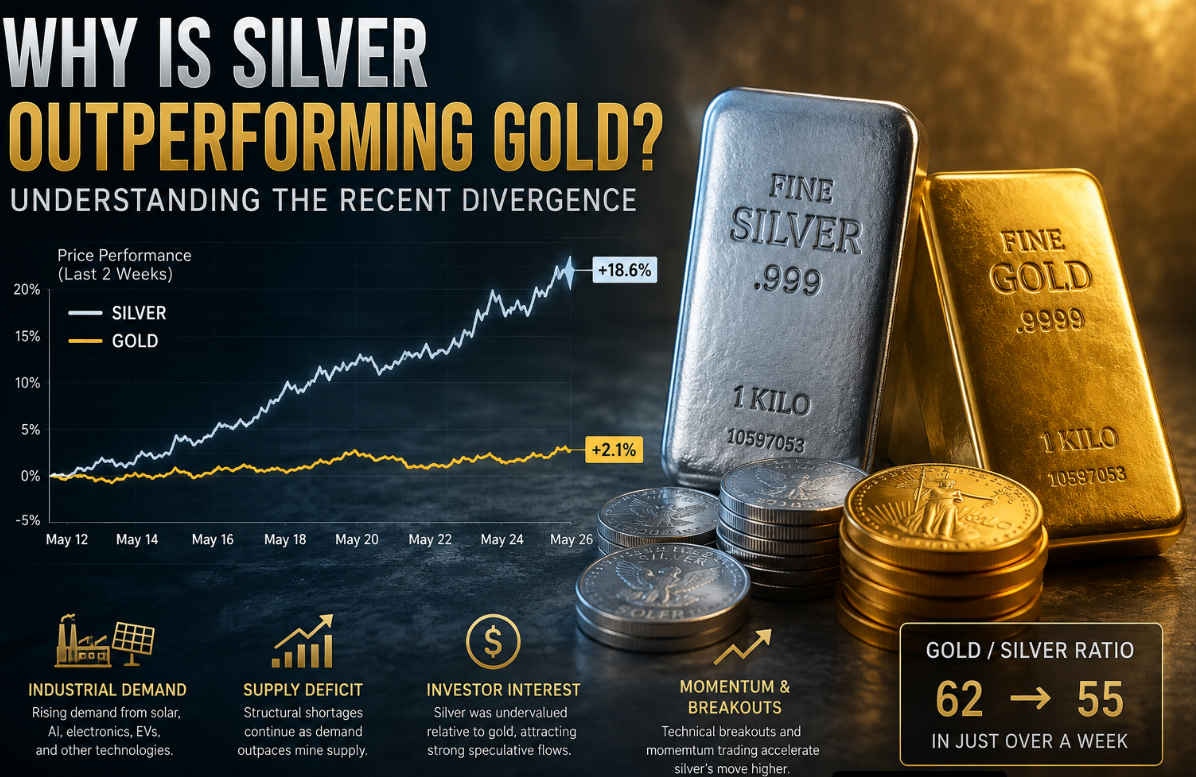
While gold has largely consolidated and traded sideways after its enormous run higher, silver has accelerated sharply upward, with some sessions showing gains several times larger than gold’s daily movement. The divergence has caught the attention of investors, traders, and precious metals dealers alike.
The Gold/Silver Ratio Is Falling Fast
One of the clearest indicators of this shift is the declining gold-to-silver ratio.
The gold/silver ratio measures how many ounces of silver it takes to buy one ounce of gold. When the ratio falls, silver is outperforming gold.
Recent reports show the ratio falling rapidly from roughly 62 to below 55 in just over a week — an unusually sharp move.
Historically, this type of compression often happens during the more speculative and momentum-driven phases of a precious metals bull market. Gold tends to move first as investors seek safety. Silver often follows later, but with much more volatility and speed.
Silver Has a “Dual Personality”
The biggest reason silver is moving more aggressively than gold is that silver is not just a precious metal — it is also a critical industrial metal.
Gold demand is driven primarily by:
- Central bank purchases
- Jewelry demand
- Investment demand
- Safe-haven buying
Silver participates in those same markets, but it also has enormous industrial demand tied to:
- Solar panels
- AI infrastructure
- Electronics
- EV production
- Battery technology
- Medical applications
As economic optimism improves even slightly, silver can begin trading more like a growth commodity than a defensive asset. Recent market commentary points specifically to AI infrastructure and industrial demand as major contributors to the recent silver rally.
That creates an unusual situation where silver benefits from both:
- Safe-haven buying like gold
- Industrial growth expectations like copper
Gold does not receive that same industrial-demand boost.
Silver Was Also Oversold Relative to Gold
Another major factor is positioning.
Gold had already experienced an enormous rally and was sitting near historic highs. Silver, while strong, had lagged behind gold for much of the earlier move.
Many traders believed silver was undervalued relative to gold. Once momentum returned, speculative money poured into silver rapidly.
Several analysts noted that silver broke through important technical resistance levels around the $80 area, triggering algorithmic and momentum buying.
Silver markets are also much smaller than gold markets. That means it takes less capital inflow to move silver prices dramatically. As a result:
- Gold often moves steadily
- Silver often moves explosively
That volatility works in both directions, which is why silver historically experiences much larger percentage swings than gold.
Supply Problems Are Becoming More Visible
Silver’s supply fundamentals are also tightening.
According to multiple market reports, silver has been running structural supply deficits for several consecutive years. Industrial demand continues rising while mine supply growth has struggled to keep pace.
Unlike gold, much of the silver used industrially is consumed in small quantities that are not always economical to recycle. That gradually reduces available above-ground supply.
When investment demand suddenly increases on top of already-tight industrial supply, price spikes can become violent.
Why Gold Has Been More Stable
Gold’s slower movement does not necessarily indicate weakness.
In many ways, gold appears to be digesting its previous historic advance. Rising bond yields and speculation about future Federal Reserve policy have created short-term resistance for gold prices.
Gold also behaves differently because its market is much larger and more liquid. It generally attracts:
- Institutional capital
- Central bank reserves
- Long-term wealth preservation buyers
That tends to dampen volatility compared to silver.
In short:
- Gold is acting like a mature monetary asset
- Silver is acting like a high-beta precious metal
What This May Signal for the Precious Metals Market
Historically, when silver begins strongly outperforming gold, it often signals increasing speculative confidence in the broader precious metals sector.
That does not guarantee prices will continue rising uninterrupted. Silver is famous for sharp corrections and violent volatility. But the recent divergence suggests investors are becoming more aggressive rather than defensive inside the metals market.
If inflation remains elevated, industrial demand stays strong, and investors continue seeking hard assets, silver may continue to outperform gold in percentage terms over the near term.
However, gold still remains the foundational monetary metal and tends to hold value better during periods of panic or severe financial stress.
The current market appears to be transitioning from a pure “fear trade” dominated by gold into a broader precious metals rally where silver’s industrial and speculative characteristics are taking center stage.